Problem Students Face Commonly while using eviews for their assignment
EViews is powerful. But it is not always for the beginner. EViews practical implementation requires both conceptual clarity and technical precision. Here are the most common problems we treat.
Inability to Understand Model Assumptions
Commonly students run models without checking:
- Stationarity & Unit Root Testing
- Autocorrelation
- Heteroskedasticity
- Multicollinearity
For example, running ARIMA models without confirming stationarity can lead to completely misleading results.
Confusion While Working with Time Series Data
Time-series analysis involves:
- Lag selection
- Differencing
- Model diagnostics
- Forecast evaluation
Even small errors in lag length selection affect forecasting accuracy. Many students get stumped with interpreting correlograms or AIC and SIC values.
This is where our Eviews homework help becomes practical and structured.
Panel Data Complexity
Panel data analysis requires understanding:
- Fixed effects
- Random effects
- Hausman test
- Cross-sectional dependence
Students often struggle with knowing the correct model to use and being able to support it academically.
Trouble with Advanced Models
When assignments move beyond simple regression into:
- Multivariate Systems (VAR)
- Vector Autoregression
- Granger Causality
- Logit/Probit models
- Logistic regression
- Structural Equation Modeling
The technical difficulty is considerably greater.
Interpretation of Output
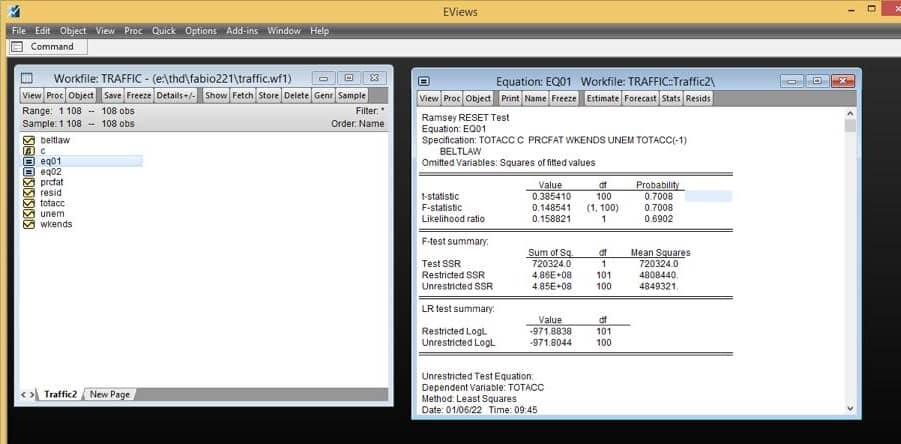
EViews produces detailed outputs. But interpreting Coefficients, P-values, R-squared, F-statistics, Diagnostic tests in an academically correct way is where many students lose marks.
Poor Data Handling and Visualization
In advanced data analysis, data Visualization and presentation matters as much as computation.
If any of this sounds familiar, you are not alone. And you do not have to figure it out alone either.